
The Duke of Parma at the 'V Encontro do Grupo Estudos Pessoanos'
Two members of the research team presented papers on The Duke of Parma at the conference in São Paulo.
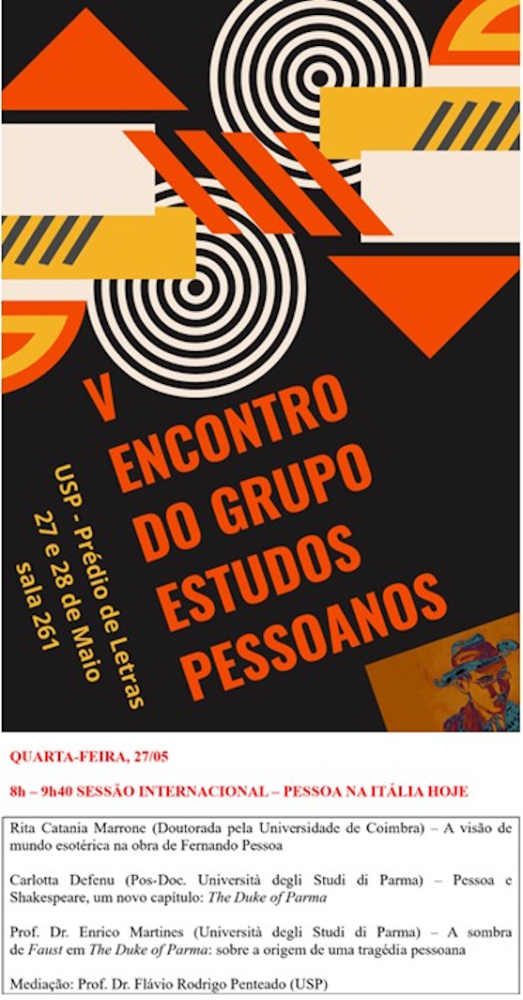
Carlotta Defenu and Enrico Martines took part in the 5th Meeting of the Pessoa Studies Group, which was held at the University of São Paulo (USP) on 27 and 28 May. During the conference's opening session, 'Pessoa in Italy Today', which took place online, they presented two papers on The Duke of Parma.
Carlotta Defenu, Marie Skłodowska-Curie Postdoctoral Fellow at the University of Parma within the project The Unveiling of Fernando Pessoa's Literary Legacy: The Duke of Parma (THEDUKE), presented the paper “Pessoa and Shakespeare: a new chapter”.
Drawing on archival research into the genesis of Pessoa’s dramatic work The Duke of Parma, the paper argued that Pessoa’s primary concern was the psychological construction of his characters, especially the Duke, rather than plot development or theatrical performance. In this respect, Shakespeare’s influence proved crucial, with Hamlet emerging as a key model.
The study highlighted several parallels between the Duke of Parma and Hamlet. In both works, the protagonist’s alleged madness drives the action: Hamlet’s erratic behaviour unsettles the Danish court, while the Duke’s outbursts provoke suspicion and conspiratorial reactions within his duchy. Both plays devote considerable attention to secondary characters who discuss and interpret the protagonists’ mental states, presenting their instability as a political threat rather than a purely personal condition.
Further similarities concern the protagonists’ relationship with madness itself. Both display an unusual degree of self-awareness, oscillating between denial and strategic acceptance. Their language remains deliberately ambiguous, resisting straightforward interpretation, while their rejection of social conventions and courtly decorum sets them apart from those around them. At the same time, both are portrayed as uniquely capable of perceiving and expressing deeper truths in environments marked by corruption and hypocrisy.
The paper concluded that Shakespeare provided Pessoa not only with stylistic inspiration but also with a structural and philosophical framework for exploring identity, power, political manipulation, and the complex boundary between madness and lucidity.
Enrico Martines presented a paper entitled "The Shadow of Faust in The Duke of Parma: On the Origins of a Pessoa Tragedy".
The paper investigates the possible relationship between Fernando Pessoa’s unfinished tragedy The Duke of Parma and the broader European Faustian tradition. It focuses on the recurring appearance of Parma as a dramatic setting. Beginning with a suggestive parallel to F. W. Murnau's 1926 film Faust and Ferruccio Busoni's 1925 opera Doktor Faust, the study traces the origins of the 'Parma episode' back to earlier Faustian sources. It demonstrates that Parma does not feature in Goethe's Faust or the earliest prose and theatrical adaptations of the legend but rather emerges in the German popular theatrical tradition and puppet plays from the seventeenth century onwards. In these adaptations, the court of Parma becomes a privileged setting for erotic intrigue and courtly seduction involving the Duke and Duchess of Parma. While there is no documentary evidence suggesting that Pessoa was aware of this particular tradition, the essay posits that Parma had already permeated the European Faustian imagination by the time he started writing both Fausto and The Duke of Parma.
The essay further proposes that these two works should be read as complementary explorations of the same ontological crisis: whereas Fausto dramatises the paralysis of knowledge and will, The Duke of Parma translates this crisis into the domains of sexuality, misogyny and political power. Thus, Pessoa transforms Parma from a conventional setting of erotic action into a symbolic space where desire is endlessly analysed, feared and denied, making the tragedy an expression of the impossibility of experience itself.
